In producing his 2013 book of conceptual poetry Of the Subcontract: Or Principles of Poetic Right, British writer and editor Nick Thurston outsourced the “writing” of the poems to anonymous digital laborers through Amazon’s Mechanical Turk. Named after the famed eighteenth-century illusory chess-playing automaton, Amazon’s crowdsourcing marketplace allowed users to assign small digital tasks to precarious, underpaid workers—a platform the company once described as "artificial artificial intelligence.”
Though credited to Australian writer and scholar McKenzie Wark, the book’s foreword was written by a ghostwriter in Lahore via Freelancer.com at a cost of USD 75, and effuses:
“Poetry sets a sky aflame at sunset, magically transforms a familiar landscape into a snow-white wonderland, and prints a clump of daffodils with the glow of soft sunlight.”
Thurston describes himself as a writer and editor who makes artworks, mining the nebulous gray zones between poetry and contemporary art. From 2006 to 2018, he was part of the influential collective Information as Material (iam). Founded by Simon Morris in 2002, iam was the first British imprint dedicated explicitly to the production and dissemination of “conceptual writing,” a new avant-garde poetics Morris has described as a “fusion or (con)fusion of art and literature.”
Writing in The White Review in 2014, Thurston articulated the need for a new poetics able to address the conditions of the present. While the surface of twenty-first-century life is marked by an incessant flood of images, he writes, “its depths, structures, flows and our interactions with them have proved more dependent than ever on written language”—a visual landscape underwritten by computational data in alphanumeric code. The new features of contemporary life, Thurston argues, are being reconfigured beneath the surface through relational networks we are scarcely able to describe. What kinds of literacies are needed, he wonders, to read these new textualities?

Wary of these experiments remaining mere abstract intellectual exercises, Thurston tests his propositions in the “wild.” He has addressed these questions through an array of books, exhibitions, artist’s publications, public talks, art criticism, and interventions dealing with topics including the rise of the transnational far right (the exhibition Hate Library and the co-edited volume Post-Digital Cultures of the Far Right), libraries as artworks and sites of care and resistance, and what he terms “document practices”—artistic strategies of republishing and re-circulating already public documents through recontextualisation or even creative misuse.
In 2026, Thurston released a new artist’s publication, Always More, with The Everyday Press. The loose-leaf tabloid collection of poems comprises selections from the margins of Thurston’s previous works and reading notes (2013–2025), reworked for density, intensity, and brevity. Presented on unnumbered loose sheets, the publication invites recombinatory acts of opening and reading. Interspersed throughout are eight short “Pathways” texts—critical responses by invited contributors: Lucy Alford, Elaine Auyoung, Kate Briggs, Johanna Drucker, Craig Dworkin, Sarah James, Andrew Hui, and Nicholas Thoburn—which offer ways into and out of the collection.
White Fungus editor Ron Hanson interviewed Thurston to learn more about the new publication and his larger body of work.

Ron Hanson: Let’s start with the title of your new publication, Always More. In a sense, the title conjures up the ravenous nature of capitalism and its forestalling or denial of any limits—there are always more flows to master and feed into the machine. But perhaps it also alludes to the vast reservoirs of language and data that underpin our image-saturated world, a deep pool you’ve spoken of making visible as material for a contemporary form of poetry. The loose-leaf structure of the publication is also suggestive of that expanse. While offering multiple reading approaches, it also dissipates the potential for any rigid frame. How does this title relate to your conception of our contemporary state of language?
Nick Thurston: There’s a book from twenty years ago by a British geographer, Nigel Thrift, called Knowing Capitalism. It wrestles with language in smart but plain ways to try to figure out how we might describe capitalism as a form—as a constantly evolving set of related practices that have shape—and then explain why it matters to understand capitalism formally as a knot of energies with distinctive internal dynamics and external effects.
I think the gains of Thrift’s wager are worth something. Our vocabularies and frameworks are constantly going out of date. We need to re-set descriptive basics again and again, though we usually cope by introducing half-measures and modifiers (x-capitalism, y-capitalism, etc). So, inside Always More is a second book—a pocketbook you can cut out, like a parasite or infection, then staple once to extract a 28pp standalone bookwork or poem. It's called “Janus.” It tries to feel out, in words, that shape or formation which Thrift and others call neo-liberal capitalism. It tries to feel it out because I think there’s a kind of felt truth to the way we each experience life in this knot called capitalism.
To give that feeling some articulable structure, I used a simple constraint: the abecedarian order of a book index—one that has no reference locators (no pages to refer to) and so constantly defers or cross-references other entries in the index. For example, it opens: “Always. See More… Backcast. See Unequal… Changeable. See Work,” with each entry set on the top line of its own page. You can follow the poem two ways: A to Z, by bound order of the entries; or via the cross-references, which link all the entries together once, in a different web.
Either way, the poem gets pulled across the surface of this knot or form, capitalism—trying, with all the inadequacy of language, to speak of the shallow impression that form leaves. The pulling force comes from this sense that capitalism has a unifying, singular logic: more. Yet we’re forever pushed away from seeing it or saying it by the undertow of this forceful moreish-ness—the fact that it’s forever shifting shape as it constantly accumulates, adapts, and internalises, in ways that are intensifying again with the onrush of Big Tech’s version of AI.
In that spirit, “Janus” is the weird little prosthetic heart of Always More. But the title itself, Always More, is lifted verbatim from the refrain of another poem in the collection, “Vector of Abstraction.” It’s a poem that has three short stanzas and, for me, an unusually regular pattern. Instead of speaking of capitalism’s form, this one tries to speak of its movement—that relentless will to exceed, or its vectoral excession.
“Vector of Abstraction” owes a huge debt to McKenzie Wark’s classic analysis in A Hacker Manifesto, which I still think is one of the most prescient books of critical theory from the early ’00s. In fact, that poem’s first form, back in 2016, was an experiment in tabular organisation that failed in an odd way. I wanted to write a poem as a spreadsheet (or a spreadsheet as a poem)—cell entries that could be meaningfully read across rows and vertically in columns to arrive at various outcomes, without a conventional grammar but with another logic.
But it was boring. So I simplified the tabulated structure in the way one might calculate a budget on the back of an envelope, then had this pared-back version of the tabulated poem letterpress printed on the back of the envelopes for my own unopened bank statements. It was printed with too much bite—too much pressure—so the poem is effectively blind embossed into the sheets of the statement inside, haunting the paper.

Even though the poems in Always More are super-short—in some cases, super-super-short—I hope the newspaper format plays its part in conceptually expanding this sense of too-much-ness or excession. The layout is full of overlays. The pages are oversized. And of course, the sheets have a high level of show-through. Everything coalesces. Nothing can be cleanly separated. And they get stained by the sun—the paper yellows.
I want that too-much-ness to flood the experience of reading Always More because I hold on to the hope that excession can work two ways: It can flatten you through the force of overwhelm, of interpellation, and the like. But it also creaks and cracks and splits open lines or paths for “something else”—something that might not quite be an escape but could be slightly better.
I really value things that can sustain contradictions, which allow two contrary possibilities to be, in their own truth, at once—because that’s how I feel about most things, most of the time. Which is a very long-winded way of getting to your question about contemporary language… because I think language is like that, and always has been. It can be an overwhelming flood (too many words, too sharp a meaning, too many things connected) or a key that opens unexpected doors (I don’t know what it was meant to mean but it's enabling me to think…). I really think that’s the wonky wonder of language, which literature just emphasises or plays to.
I’m interested in what big and small social and psycho-social forces do to us via language. If I had to nominate one voice of the contemporary state of language, it would probably be some sort of Gen AI Voiceover software—a “voice” that can say anything in any tone/style of speech, and will never really care about the perlocutionary effects of what it does. Against that reality, maybe all we have is song, allegory, etc., in the cracks of something possibly better. But amongst that reality, I think we can say more. I think we’ll always be able to think and say and do more with the right kinds of effort. Hegemony can never repress all its contradictions.

RH: As part of the release of Always More, you gave a presentation with Kaja Marczewska and Nick Thoburn at the Biblioteka Art Book Fair at The Warburg Institute in London. During the event, you collaborated with the audience to make a slide deck—taking turns selecting historical images and then discussing them. You’ve described the endless connections generated through this process as resonating suitably in that setting, with its aura of Aby Warburg and his unfinished Bilderatlas Mnemosyne (ca. 1924–29)—a series of wooden panels covered in black Hessian upon which he pinned constantly changing or rotating clusters of images mapping the “afterlife of antiquity.” Can you tell me more about the Biblioteka presentation and what it generated?
NT: I’m a big fan of both Kaja and Nick. I know Kaja from her work as a literary and media scholar, including her book This Is Not a Copy and curatorial experiments like Paper Struggles at Raven Row (London, 2019). Kaja actually introduced Nick and I, soon after he’d published Anti-Book. Since then, he and I have spoken and written together many times, like some dodgy double act—“The Two Nicks T's.”
There are so many aspects to Warburg’s worldview. I don’t understand all of them, and of the ones I do understand, I don’t agree with all of them. But his wholehearted commitment to the “constellation” as a multi-dimensional mode of relating to past and future in the present has been really important to me as more than just a metaphor. It gives those of us attracted to the visual and aesthetic (like moths to the flame) a way to think about or cope with the unsteadiness of our “thick now,” which people like Donna Haraway and Karen Barad have helped unconceal in a bigger picture.
The Biblioteka fair at the Warburg gave us a chance to pull Always More into that big, unsteady conversation about alternative histories of doing. Kaja showed examples of pre-modern, early-modern, and non-artistic items from UCL’s special collections, where she works. All her examples had posed problems to the cataloguing standards of the collection. Nick spoke about a couple of projects that emerged from activist contexts and challenge publishing conventions because they do not just reproduce the orderly cultures of reception those conventions help to teach.
So we loosely gathered around alternative cultures of publishing—those in which the horizons of what’s publishable there and then are explored with limited concern for convention, market, generic ideals, etc.—to improvise (rather than rehearse) some group thinking about why the edges of publishability might be worth exploring beyond simple novelty claims.
My takeaway was that the horizons of the publishable are highly socio-situational, and they help us to sense the limits of what we can write and read in that time and place. Certainly, that limit is the impossible direction I'm always aiming for—the very edges of what we can write, read, and share in a particular context. In the end, the aesthetic and political stakes of what I try to do with language spread out, like a ripple effect, from simple gestures of trying to read differently. Like trying to write an index for a thing you can’t quite get hold of, in “Janus,” for example. Or, as with Always More, trying to sketch a poetry that can speak with (not just about) the forces it explores in an overcooked mediascape that is re-wiring us to be postliterate.

RH: I’m interested in the processes of selecting, commissioning, or assembling the texts in Always More. The book contains recombined poem-texts drawn from the margins of your previous works and reading notes (2013–2025), privileging “density and intensity and brevity”—the space around the words becomes perhaps as important as the words themselves.
But it also includes a number of short “Pathways” texts from contributors such as Thoburn, Johanna Drucker, Craig Dworkin, and other notable figures from the worlds of artist publishing, experimental literature, and critical theory. How did you approach those earlier works when identifying relevant texts? Could you take us through some of this marginalia for a moment? And what are Pathways texts and their functions?
NT: It’s funny you ask. The process of selecting older work was confusing and riddled with false starts.
Four or five years ago, I set about a practical reset of how I work because we were moving house, expecting another child, and my old method (travelling a lot, etc.) just wasn’t sustainable. As part of that, I started to organise a single digital archive of all my older work and writings (scraping old external HDs, scanning contributions done for obscure DIY publications, etc.). I kept finding poems or ideas for poems I’d forgotten about—some were written, some half-written, some sketched as materially-specific objects in notebooks, some plain terrible. That got me interested in a “selected works” type collection, mixing published and unpublished bits, focusing on things found or lifted from the edges of previous projects (hence the assignation “marginal poems”).
When I started to see and read these poems next to each other, the discrepancies were jarring. They were mostly fragmentary or super-short in form, and they were conceptually, stylistically, and materially erratic. Squeezing them all to fit one plaintext stylesheet was deadening. When I typed them into a simple manuscript, it was death by typographic standardisation—a conventional book would be a coffin for these poems. That ruled out the easiest way of doing it (perfect-bound volume) and all conventional publishers (indie publishing looks vibrant on the surface but is incredibly materially conservative on the inside, because of cost and distribution logistics).
From all that, three editorial principles became clear: (1) this couldn't be a conventional book; (2) I needed to iteratively re-work the included poems to nurture relationships between them; and (3) the false coherence of a “collection” (an ordered set based on a unifying logic) didn’t make sense because this was a gathering, the sediments of a period (2013–25). The best metaphor I can think of for Always More is that it’s a knot: The poems are like threads that come from elsewhere and could be untied for use elsewhere after this.
That’s why I knew it had to be unbound sheets, which was the first step towards its becoming a newspaper. I had to exclude all those poems that were too specific to a context or a material process. The poems that are included are all minimal if not Minimalist. They’re like annotations wilfully over-read (hence, again, the “marginal” label). Which gets to the second part of your question…
For a while, I really couldn’t answer the question, who is this for? And it probably took so long to finish (despite being c. 250 words in total!) because I worried the answer was just me. So I started working with a friend on the design, Joe Gilmore, and asking friends and readers I admire to take a look at what we were composing, which is how the Pathways feature emerged. I needed to know this would be generative for other people and not simply vain.
The Pathway authors got the PDF layout and photos of a printed dummy on a newsheet to demonstrate the format. The invite was to write 200–250 words (the same as the whole manuscript!) that propose a reader's way into or out of the poems. What did the poems trigger them to think about? Then we distinguished those Pathways in red ink and hung them typographically from the centre line with a ragged bottom. They’re not “about” the poem they’re nearest to per se—they’re more dotted through like notes or Post-its.
RH: This isn’t the first time you’ve outsourced text for one of your publications. In producing your 2013 book Of the Subcontract: Or Principles of Poetic Right, you subcontracted the writing of 100 poems to anonymous workers on Amazon Mechanical Turk, though you were credited as the author of the book (the platform was shut down by Amazon in 2026 amid the rise of generative AI). The poems, written from positions of precarity, were arranged according to the cost of production, with even the foreword commissioned from a ghostwriter in Lahore through Freelancer.com.
What, if any, personal expression came through in these apparitional compositions? And what does this experiment—conducted deep within the corporate machinery—tell us about writing in the twenty-first century?
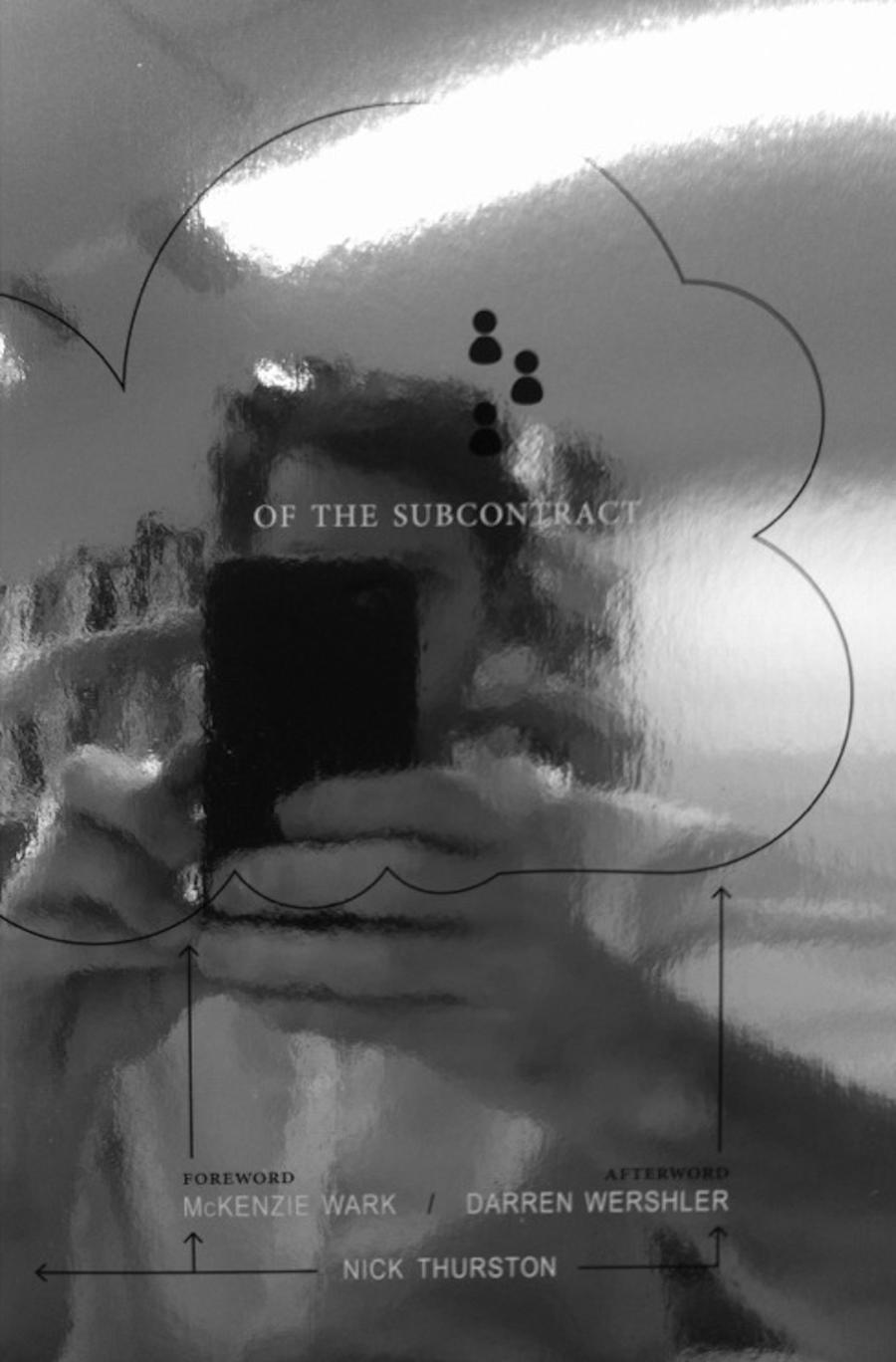
NT: It’s thirteen years since the first edition was published, and at least sixteen years since I started working on it. Socially and technically, a lot about language use has changed, most obviously the overwhelming creep of generative AI. But I think Of the Subcontract does show that the economic and political roots of these changes have been deep and growing for a long time.
By the start of the 2010s, I’d become fascinated by the long and occluded media history of writing machines and the machining of writers. At the time, proto-AI text generation labs and businesses (e.g., the Long Tail algorithm) were clear indicators of what’s come since, even if nobody wanted to acknowledge it then. But I was also interested in medieval scriptoria (monastic spaces for copying spiritual texts) and speech generated under spiritual possession (vocal channels), and things that typically sit outside the historiographic purview of literature and the arts. It was clear by the 2010s that the arts were a long way behind real-world changes in language use. Maybe they still are.
Across the 2000s and early ’10s, the platformatic basis of the “gig economy” was being publicly tested by startups and Big Tech. So-called online “labour pools” were an early example. Amazon launched the beta version of their platform for crowdsourcing the completion of “Human Intelligence Tasks” in 2005. They called it Mechanical Turk. From the Orientalist slur in its title (a reference to a fake chess-playing machine that fascinated Europeans in the eighteenth century), the whole platform was flooded with muddled fantasies about how labour value could be exploited.
Its shortest, sharpest, most arresting horror, for me, was the original strapline for the service: “Artificial Artificial Intelligence,” which I’d translate as an underpaid transnational labour pool for people who will do the tasks that computers can’t yet quite manage. (That strapline is typeset as a sad face emoticon, with the inverted Amazon logo for its mouth, as a poster-poem in Always More.)
I wondered what was happening, at the level of subjectivation, to people recast as “Artificial Artificial Intelligence.” I didn’t want to peddle some fake liberationist fantasy. I couldn’t grant Workers some grand sovereign autonomy as Authors. I had no interest in judging people who choose to sell their labour power this way—I learned about these pools because an ex-girlfriend did exactly this sort of work, as a photo retoucher.
I really just wondered what happens to poetry under the force of this subjectivation, and what the compositional footing might be for someone like me, who is complicit in the problem because I’m there as a privileged spectator. Complicity is the gravitational force here. That’s why the first English edition has a cover printed on a mirrorboard card—the reflection calls your distorted image of self into the picture whenever you pick it up.
I can’t speak for the Workers or their poems. That was always part of the point, for me. But I was asking, what is the role of language in this coming change embodied by the fantasy of general artificial intelligence? And what could be said and read in the name of literature from within these circumstances? It’s up to readers if they interpret the poems in Of the Subcontract as answers, as symptoms, as red herrings, or as anything else.

RH: As language evolves and becomes more unstable (with nearly every thought becoming published or publishable, and the reader approaching near-total absorption into online forums and platforms), it has been striking to see often frightening echoes of a dark past that liberalism thought it had buried once and for all in the neoliberal, “post-historical” global order.
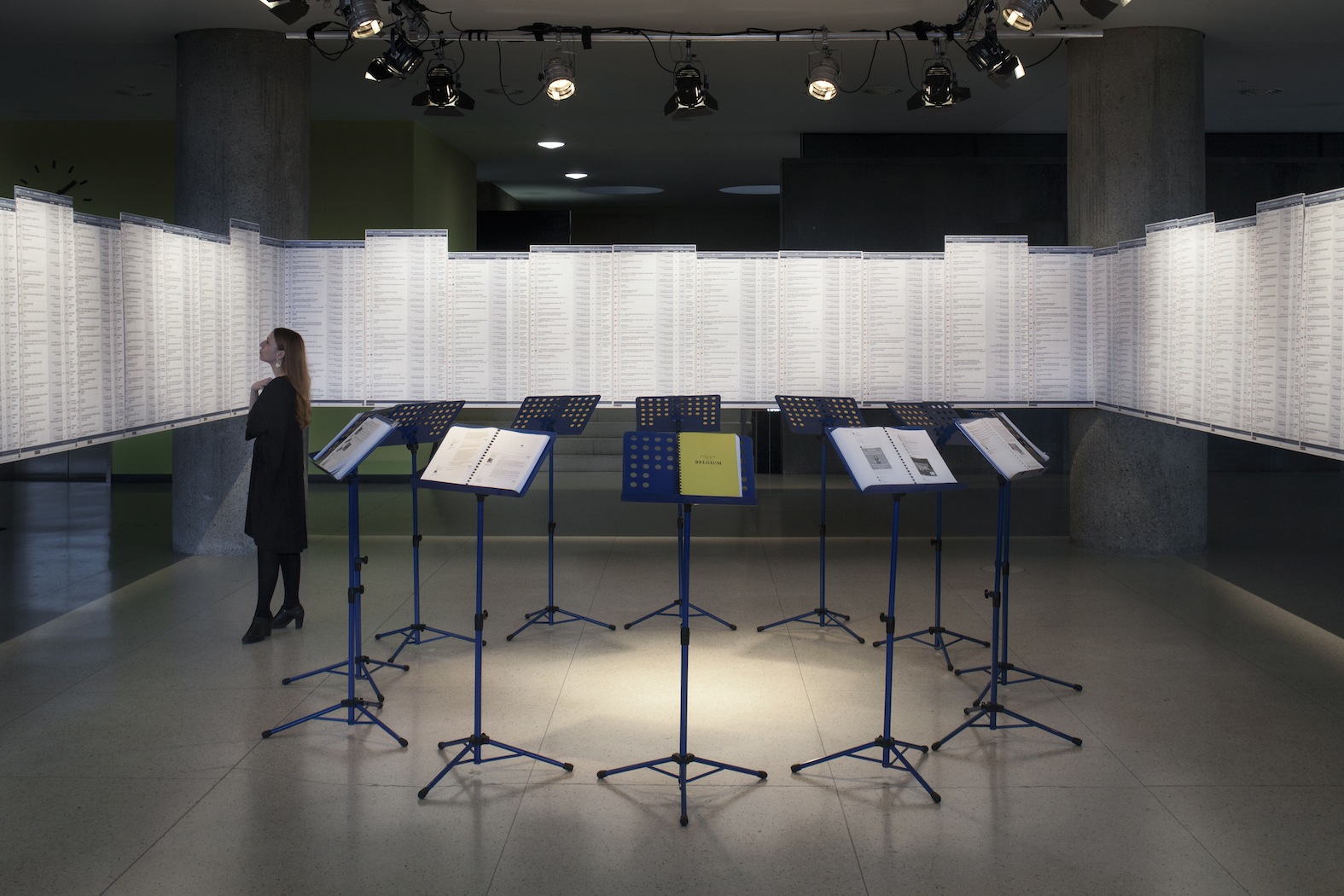
In your 2017 exhibition Hate Library, a multimedia installation and twelve-volume bookwork, you unflinchingly explored these discomfiting resonances. The work examines the language and communication strategies of far-right political groups across contemporary Europe. Functioning as a public resource library, the installation was presented in the shape of the European flag—a symbol of a fraying, once-optimistic project.
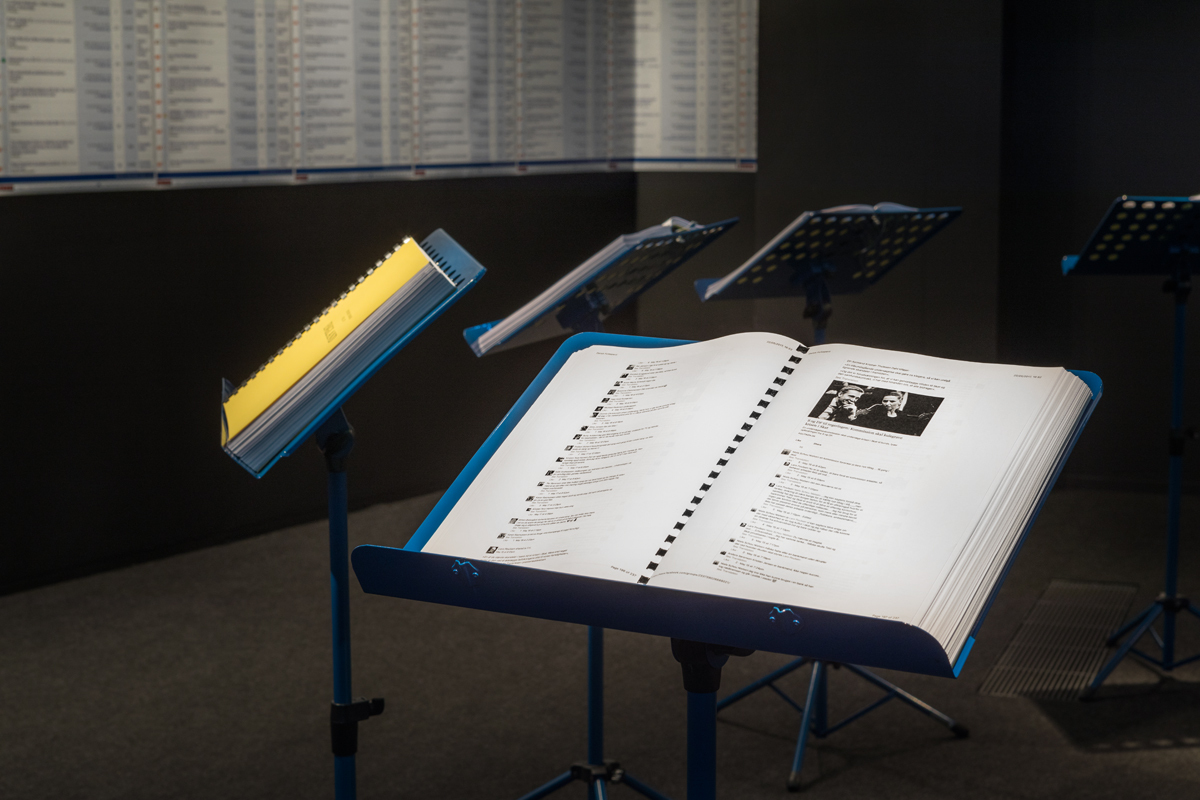
On blue orchestral lecterns, you placed yellow-bound “History Books” containing unedited tracts of ongoing discussions among supporters of twelve of Europe’s most significant far-right groups and parties. The viewer is also confronted by imposing wall texts that enlarge excerpts from some of these texts, resituating them from their original dark crevices of the internet within the hushed setting of the gallery. Following the exhibition, you also co-edited with Maik Fielitz Post-Digital Cultures of the Far Right, a book that explores this transnational movement in depth.
Can you tell me a little about the exhibition and what you learned from it? How have evolving forms of language and communication enabled or amplified these groups? While the ideology is remarkably similar, how does this newly reconstituted far-right differ from its historical predecessors? And what does the recontextualisation of these texts within your exhibition offer the viewer or reader?
NT: I don’t think languages have a politics or one ideological value. I think, like all technologies (and I mean “technology” in its broadest sense, of human-produced things, even if we have some innate or primal drive toward communication), languages can be equally well put to different political means, including contrary political aims. Different political wings use the same language—language is a shared problem. I know that’s really obvious, but I think we often obfuscate it by misusing the word “language” when we mean something narrower, like vocabulary or rhetorical style. That obfuscation helps us feel some sense of moral possession or territory, as in, “our language is not the same as their language!”
I’ve always been interested in the politics of languages, in part because I’m dyslexic and using language “properly” isn’t something that comes easily to me. I’m naturally inclined to use it improperly, and my politics follow suit (chicken/egg, egg/chicken… who knows?). So I’m interested in the social and personal realities of how languages get used, misused, and reused, rather than in their rules or conventions or finest examples. And I’m more interested in textual acts than oral ones. That brought me to realise, quite quickly, that I’m interested in how writing and reading become public—and “to make public” is the root meaning of “to publish”—which is why I call what I do a “praxis of publishing.”
What all this put front and centre, for me, is the question of public-ness, of the qualities of being public that certain things and situations enjoy or foster or block—which is different in emphasis from the dominant literary question of how a private or personal authorial voice expresses or confesses an inner truth to its outside (a receiving audience). And this question of public-ness, in relation to scriptural cultures (writing and reading), has a civic interface that is especially important to me, the public library. For a long time, I’ve been interested in the possibility of making temporary, functioning public libraries as artworks.
A decade or so ago, when I was writing a lot about writing machines, digital publishing infrastructures, etc., a friend told me about the fringe- and far-right subcultures flourishing online. This stuff has become common knowledge, but at the time, it was quite surprising that nationalist communities were developing transnational support networks to bolster one another’s cause.
This friend was a scholar and expert adviser on the topic. I was blown away by some of the stuff he showed me. As sickening as I might find their purposes, some of the innovations are really impressive in terms of boot-strapped DIY network building. Hate Library emerged from the coincidence of all this, from a place of horror and genuine curiosity.
I used to think simple gestures were blunt, but I slowly came to find, when doing more project-based “critical” work, that there’s real value in distilling something that is clear. And that clarity can also be sharp. Hate Library was composed in that vein, to cut. It was a very complex process that “makes public” something very simple.
We worked with activist-researchers around Europe who were studying the national far-right movements in their country. Each researcher identified the key online communication channel used by the leading fringe or far-right group in that country (Facebook, etc.), and we downloaded huge digital troves of each group’s exchanges on those semi-public channels (message groups, discussion threads, etc.). Everything was just a few clicks away on the open Internet, but you’d never find it if you didn’t know how and where to look.
One fundamental value of the hard-right imaginary is conservatism, in the proper sense of a desire to conserve or preserve those power relations that have served the dominant groups thus far. This needs a historiographic model that uses History to tell a story of progress, one that reproduces conventions of exclusion. History books are a key ideological tool in that historiographic tradition (textbooks, “the approved version,” etc.). These kinds of definitive accounts belittle their exclusions, as if politics were just an expression of pseudo-natural laws (law of the jungle, survival of the fittest, separating wheat and chaff… pick your idiom).
At the heart of Hate Library are twelve 700+-page volumes we called “History Books,” which are intended to invoke exactly this idea. Each volume is an unedited, unabridged 1:1 core-sample or slice of the conversations between participants in the most active nationalist forum in one European country. Each book is A4, print-on-demand, spiral-bound—effectively just a PDF created by pressing “Print” on the webpages of that forum, then sized to fit the printer’s spec.
All the other artworks and staging decisions in Hate Library were built around those core library “holdings.” The exhibition was a functioning reference library that created a public stage (an installation, in the old theatrical sense) for those History Books to be read sociably (alongside other people, in real life, as opposed to the atomism of online prosumerism). It was a simple forum that shared or republished (as in, made public again yet differently) these everyday discourses that most of us would rather ignore.
In generic, artistic terms, I think about this kind of work as a form of experimental documentary arts practice, or what I’ve called “document practices.” The premise is to republish already public documents to encourage different/new kinds of cultural readings. A conventional art catalogue for the project would have just been a classic example of the history book genre, which canonises certain interpretations of an artwork. It didn’t make sense.
Instead, beyond the artwork, we took the invite to publish as a chance to edit an introduction about this burgeoning culture. We wanted to find out from experts in the field how these online networks were meaningfully affecting offline life (and vice versa). That’s how Post-Digital Cultures came about. I’m sad to say it foresees a lot of what has come since, e.g., the Alt-Tech movement and Truth Social.
RH: One of the disorienting things about the rise of this transnational far right over the past decade has been the evident pleasure its members take in their transgressiveness. Whereas transgressiveness and boundary-pushing were once characteristic of left-wing countercultures endeavoring to subvert or dismantle entrenched hierarchies and other repressive forces, much of that energy has been claimed or repurposed by the right.
For all the disturbing values it espouses, the contemporary far right does function as a form of counterculture, providing its members with a sense of belonging and purpose. I’m interested in your thoughts on the possibilities for creating potent, non-repressive countercultures in this new and rapidly changing environment.
NT: I agree. Trolling is the form it most commonly takes, but the desire to transgress or override is all over meme culture, manosphere bubbles, and the like. It’s all premised on the mindset that life is fundamentally conflictual—it’s a matter of beat or be beaten. I guess, to develop a non-repressive counterculture, you’d have to somehow resolve this “beat or be beaten” obsession. Maybe then, it couldn’t be “counter-” anything. It would be non-conflictual. Maybe this is where the renewed interest on the Left in religious or spiritual answers is coming from, all the way up to eschatological thinking.
The best I can imagine is something multiscalar and ethically (rather than politically) centred. It would have to offer answers that precede Left-versus-Right divisions. It wouldn’t involve telling people their thoughts or feelings are wrong; it would be about showing them that something better is possible.
I really don’t think art offers practical solutions for political problems. But I sincerely believe it’s one space where the possibility of living differently together is held open by the obstinate presence of the work. The sheer fact of the artwork—that it has to be somehow legible—is a speculative promise that sustains a different imaginary. Precisely because the artwork persists as an interface between what we do know (what it is) and don’t know (what it means), art offers a concentrated reminder of the possibility that we can always imagine a different way of relating to the world we share. That’s as close as I get to a religious conviction. It’s also the contrary sense of “always more” that lives, as an internal contradiction, in those poems.
RH: Beyond Hate Library, the library, both as a physical site and concept, has long played a major role in your work. You’ve written about and created your own examples of what you call “speculative libraries”: artworks that are libraries but challenge the classical fantasy of libraries as complete, stable, objective, and authoritative. You differentiate these from artworks that are merely about libraries: They function as actual libraries, connecting people to publishing cultures. You’ve described these as posing a “double-barrelled question,” challenging both what libraries and art can be.
You also collaborated over a period of years with Chetham’s Library in Manchester, Britain’s oldest public library (founded in 1653). Together, you explored new ways of approaching its collections, architecture, and everyday life. As it prepared to reopen after a Covid lockdown in 2021, you filmed the library for your video Tender Silences, which was released alongside an eponymous newspaper tracing the history of contemporary artists’ moving-image responses to libraries.
Why have libraries become such a significant focus of your work, and how do they relate to what you’ve previously identified as a “crisis of publicness”? Can you tell us more about speculative libraries?
NT: I think of exhibitions as a kind of public forum where cultural efforts meet (those of makers, audiences, institutions/organisations, etc.). Starting in my mid-twenties, I was in lots of exhibitions about text and/or artists’ publishing. The recognition and opportunities meant a huge amount to me, especially because I was mostly living and working way off the radar of any culture industry.
With the best will in the world, displays of books and printed matter often feel staid: The mode of embodied, affective, primarily visual attention that galleries encourage (especially art galleries) excites a specific attentional mode (one that’s spatial, social, object-oriented, etc.). What I would think of as text-art or art-writing is perfectly tuned for that kind of attention. But longer, more literary forms of writing can struggle in that setting, where audiences look more than they read. Publications in vitrines, symbolising what they contain, can be a valuable museum strategy. But it mummifies the work as an artefact, and it blocks the social life of the publication (to be picked up, passed on, etc.).
It struck me quite early on that writing, reading, and publishing cultures already share another bespoke public forum: the library, especially the public library. That made me wonder, why shoehorn literary culture into contemporary art exhibitions, where people don’t feel able to read on their own terms, when we have an amazing and expansive format that is less precious, more accessible, and doesn’t reify publications or audiences?
I’ve been trying to make libraries as artworks ever since. It typically involves devising a cataloguing system, selecting and organising holdings, establishing the library’s material basis (physical room or digital), planning for preservation or dispersal, and getting readers engaged. Sometimes it involves simple furniture design, digital infrastructure, graphic identity work, and public programming. Increasingly, I’m interested in libraries as hubs for public publishing infrastructure, an interest that began with a show I co-devised for the CCA Glasgow in 2017. I don’t know if that makes me an artist, a curator, or an irresponsible librarian.
I’ve called these kinds of libraries “speculative libraries.” It’s just a rough label that helped me gather examples over the last two decades. They don’t have to be consciously made as artworks. But for me, they have to be made from the footing that good art demands: not-knowing. Each one has to take the risk of re-imagining what “the library” could be as an interface between writing, reading, publishing, and public interests. That’s the compositional risk-taking that makes them artful, for me.
That sounds very grand, but speculative libraries need only “function” at whatever scale they aim for—from opening your front room to random readers like Abra Ancliffe’s Personal Libraries Library does to a 100-year public promise like Katie Paterson’s Future Library.
Taking one step back so we can go two steps forward… Libraries and exhibitions are not the same sorts of forum. They have fundamentally different “affordances.” One of the affordances of a good library is that, if you stand in an aisle, close your eyes, and twirl around, your fingers can touch thousands of amazing ideas and images without leaving your turning circle. I love the intensity, density, coincidence, hands-on quality, and polyvocality of a good general library. It encourages porosity, access, and surprise, which is so different from the conventions of the white cube gallery, which typically isolate, protect, guard, and interpret.
For the kinds of writing, reading, and publishing I care about most, libraries (along with bookstores, fairs, and DIY presses) have been the most important public forum. In the UK, libraries were once a pillar of the civic imagination but are now being brutally cut, re-oriented, or left to rot. This neglect is one example of a broader crisis in publicness: What agency do any of us have to contribute meaningfully to the shape and change of whatever constitutes “the public sphere” wherever we live? Less than we could have or should have, I think.
In the West, we’ve got collapsing welfare states and social infrastructures, transnational corporate hegemony (particularly in relation to cloud computing dependencies), and increasing isolationism, atomisation, and competition. The public, the shared, the “we,” is in real trouble.
Publishing is, in some sense, a practice of making public. But it’s not one-way traffic. It shapes and is shaped by the publics it emerges from and spreads among in a diffractive ecology. I’m not arguing for some fuddy-duddy idea about a Republic of Letters for privileged voices. I’m saying there is public value in a culture of publishing that plays a role in constantly re-imagining what publicness is and could be. One way that culture works is by making reading experiences available that can help us explore who we are and what we share beyond what we already know or think we know.

RH: Perhaps we can end by talking more about what you term “document practices”: the act of republishing or mobilising already-public documents in creative ways, as or through art, and across contexts other than those for which they were originally intended.
You first arrived at this formulation when reflecting on your own practice, but also began noticing a proliferation of works that seemed to mark a significant break from documentary practice in their use of documents. Rather than offering readings or contextualisations of these documents, the key “unit of intention” of these works is the networking of people with documents and with storage and sharing systems that allows readers to become publishers or librarians. The art form becomes a transitional object, with the network it enables taking precedence.
Does this also relate to the crisis of publicness you mention? Where is your thinking about these practices now? And what do you see as the significance of these practices for dealing with our current moment?
NT: It definitely relates to the crisis of publicness.
Crudely put, the socio-technical context for the idea is this: We can copy, store, and share documents at previously impossible scales; in ways that are far beyond our socio-legal capacities to control or manage, or even fully track. We are constantly making, sharing, and receiving “documents” of one sort or another, and we don’t always know that we’re doing it.
The modern understanding of a “document” pegs it as some kind of trace of the past with a verifiability (a facticity) that is either real or assumed (i.e., real enough). The modern understanding of “documentary” practice is considerably shaped by the emergence of new recording and relay technologies from the nineteenth century. The magical, indexical power of photography and sound recording was key to documentary becoming a genre or cluster of subgenres. But what has been left to hide in plain sight is the root meaning of “the document,” as an inscriptive record underpinning documentarity.
Because of all the weird obsessions I’ve outlined above, I’m fascinated by the migration and social life of inscriptive records in what Michel de Certeau called “the scriptural culture” in its widest, wildest, unknowable sense. I’m thinking backwards from scores on clay tablets recording agrarian land rights, to the most routine administrative documents produced en masse in most workplaces, to the cloned PDFs sitting in shadow library databases. For me, really, the weirder the document, the better.
There are lots of long, marginalised histories of people using inscriptive documents in ways we might now call “documentary.” Scrapbooks are a great example. And there are many related, global literary histories of writers quoting or referencing documents within fictional worlds or stories. Now, there’s a flourishing poetics of what Maurizio Ferraris calls “documentality,” which involves people writing with or into documents that can be copied or altered easily through digital imaging processes.
What I’m calling “document practices” is tangled up with all of this. It’s the meta-imaging of already public documents in new contexts of relation, compositionally (combining documents in new ways, or changing them), and/or interpretatively (republishing them elsewhere, changing access). But it’s necessarily different from “authorship” no matter how simple the “republishing” gesture is, because authoriality gets overwhelmed by the documental force of the material. When a document is meta-imaged, it drags its scars, its histories, its past with it as some “thing” that is more than textual information. It stays thick with its problems. No one can control or have authority over all that.
I’m feeling out this term or label, “document practices,” in much the way I needed to peg “speculative libraries.” It’s an imperfect but functional term we can share to think together about forms of cultural practice that are estranged from established categories. For me, this label, “document practices,” has been a conceptual lever. It’s helped me begin to understand one potentially radical alter-history of editorial activity—it’s about composition as editing with the widest, lightest stance—that concepts of authorship have only occluded.


