
Tuesday, March 26, 2013—Open house at IASPIC, Stockholm.
After a few minutes, when the recording stops and following Hong-Kai’s instructions, the musicians discuss how best to reproduce what they have just heard. Within five minutes, they reach some conclusions. The pianist will reproduce Bach’s piece exactly, while the other players attempt to recreate the ambient sounds.
They begin playing, eventually leaving the recording behind and moving further into improvisation until they conclude. The audience claps, and Hong-Kai invites everyone to discuss what has just transpired. The discussion is animated, and the musicians remark how strange it is for them to talk about their work in this way. In their usual performance context, this rarely happens.
Within the art world, by contrast, critical discourse is ever-present, embedded in the presentation and circulation of work. Hong-Kai tells the musicians that Leonardo Music Journal is preparing a special issue on sound art, and that a recording of the project—including the discussion—will accompany its release on CD.
The Swedish artist Petra Bauer asks about the political implications of the piece and what it means to present a recording made in Taiwan long ago and now played by Swedish musicians. Hong-Kai’s reply addresses the importance of generating situations of collective listening as a form of political engagement.
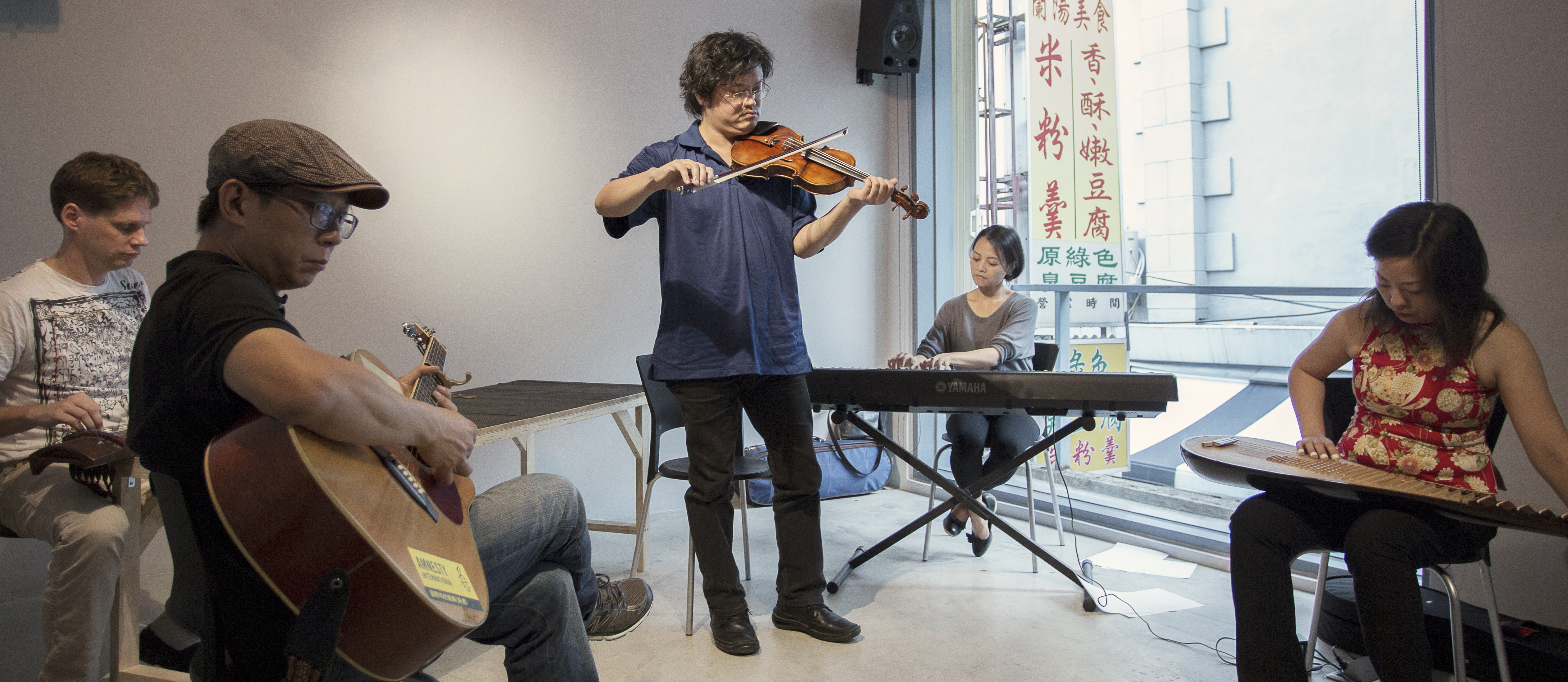
The work of Hong-Kai Wang takes displacement as a starting point to generate acts of active listening. Often using discussion as a mode of production, she destabilizes established forms of categorization: Is this music? Sound art? Relational art? Her own role is also problematized. Two years ago, she ceased claiming authorship of her projects and now describes herself as an “initiator.”
The notion of displacement is crucial for understanding not only Hong-Kai’s work but also her life. She left Taiwan in 1998 to pursue media studies at the New School in New York, where she met the composer Chris Mann, who has been her mentor ever since. She often collaborates with him in different ways.
In New York, Hong-Kai developed an acute interest in listening. As her English was not yet sufficient to fully understand what was being said, she began instead to focus on the textures of sound and the extra-linguistic elements that constitute social relations.
It was through Mann that Hong-Kai learned about avant-garde composers such as Herbert Brün and Robert Ashley. For Hong-Kai, this inspiration can often be channeled into different forms of collaboration or the integration of their work into her own activities.

In 2010, she staged an adaptation of Robert Ashley’s opera Dust in Taipei, performed in Mandarin and Taiwanese. She collaborated with political activist and composer Chen Bo-Wei, sound artist Wang Fujui, and theatre director Keng Yi-Wei. The adaptation, Watching Dust, was presented at the Guling Street Avant-Garde Theatre.
Hong-Kai’s practice walks a fine line between reproducing contemporary forms of labor—outsourcing and management—and generating something that exceeds their parameters. She often works with musicians and composers; while she makes room for their contributions, she also enforces rules so they are not totally in their comfort zones. We could say that she uses people as instruments for a “music-to-come,” in which reflection is incorporated into both its production and the social relations it generates.

If we understand agency as acting according to a rule or principle—being motivated by that rule rather than personal desire or inclination—then Hong-Kai’s practice introduces such rules within her work, provoking participants to challenge themselves and to experience their own sense of displacement.
Often her work has different layers and stages, but all the elements are part of a conceptualization-in-progress that questions its own parameters. She is frequently positioned on the boundary between a clear awareness of what she is doing and an inability to grasp just how far a situation has gone.

Sometimes the expectations of collaborators are not fully met. For example, in her project What’s the musical consequence of change? (2013) at the Arnold Schönberg Center in Vienna, she invited twelve composers from eleven different countries to engage in a conversation about their status as expatriates.
After this conversation, each composer was asked to produce a two-minute score based on the discussion. The audience was then invited to an open rehearsal. The composers in the Schönberg project were unhappy that there would be no final concert presenting their scores.
But Hong-Kai’s interest lies not in satisfying collaborators’ personal interests, but rather in encountering the gaps between different roles and contexts, as she did when she first moved to New York. Through distributing small doses of displacement, Hong-Kai generates an agency that goes beyond individual artistic production.
Mattin
Anti-Copyright
The article was written in 2013 and published in the 13th issue of White Fungus.


