
I first met Scott Arford while attending my very first actual noise music show in 2002—the fifth annual Activating the Medium Festival at the San Francisco Museum of Modern Art. The line-up that year included, among others, Arford and Sensorband (Zbigniew Karkowski, Atau Tanaka, and Edwin van der Heide). As a member of the organizer 23five Incorporated’s Board of Advisors, Arford also played a key role in directing and curating the festival.
I had previously been exposed to a variety of experimental musical genres, but the SFMoMA show felt different. The combined loudness and sonic textures engaged my whole body and perception. It became a kind of full-body contact with sound.
After moving to San Francisco from Brazil in the early ’90s, I became part of a circle of friends connected to Recombinant Media Labs and Asphodel Records, both run by the composer and curator Naut Humon. I began attending shows similar to the SFMoMA event—mostly at Recombinant Media Labs—and became acquainted with the Bay Area’s frequent “house shows,” noise music events hosted at people’s homes. Through these, I encountered a more visceral and personal approach. Arford’s own house, 7hz, was one such space. Starting in 1995, he hosted a slew of the most interesting noise acts in the Bay Area while introducing artists from around the world.
Long and narrow, 7hz was a warehouse in an industrial area of San Francisco. With its exceptionally high ceilings, twenty-foot fire pole, and nine sets of stairs, it perfectly accommodated a range of different approaches to performing noise. The space was particularly well-suited to large sound systems. Performers such as Joe Colley, Zbigniew Karkowski, Michael Gendreau, John Duncan, Emil Beaulieau, Scot Jenerik, and Francisco López all played live shows there.
7hz was emblematic of a certain aesthetic that has been an important part of underground subcultures, including the experimental and noise scenes in the Bay Area. There is a long history here of melding domestic spaces with the practices of the artists living in them.

During the counterculture movement of the ’60s and ’70s, places like The Russian Embassy (which housed, among others, Kenneth Anger and The Calliope Company), Anton LaVey’s Black House, and The Free Print Shop (which produced the Kaliflower newspaper) were all hubs for creating and housing the subcultures associated with them.
Beginning in the ’90s and spilling into the ’00s, places like The Clitstop, Huffin House, the Cyclone Warehouse (next door to 7hz), 5lowershop, The Jewelry Store, Golden Trapper Keeper Lodge, LoBot Gallery, The Purple House, The Terminal, and Life Changing Ministry functioned as hybrid living/venue spaces that played a pivotal role in fostering the Bay Area’s experimental and noise music communities. Allowing this intimate (ab)use of one’s own personal space gives room for the physical catharsis often associated with this music.
This sharing of art practice and personal space provided Arford with an initial platform for his work. After moving to San Francisco from Kansas in 1991, he began experimenting with 2D mixed media formats through painting and collage—processes that would inform his later compositions. In 1994, he moved into the space that would become 7hz.
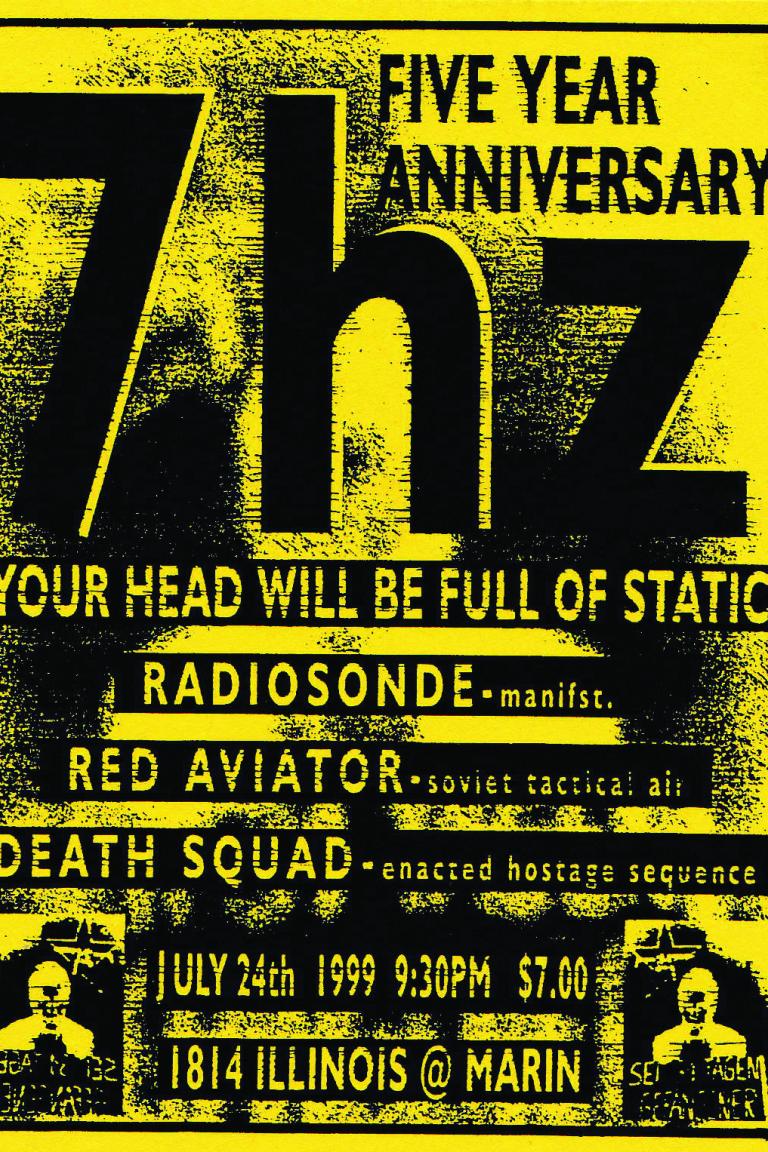
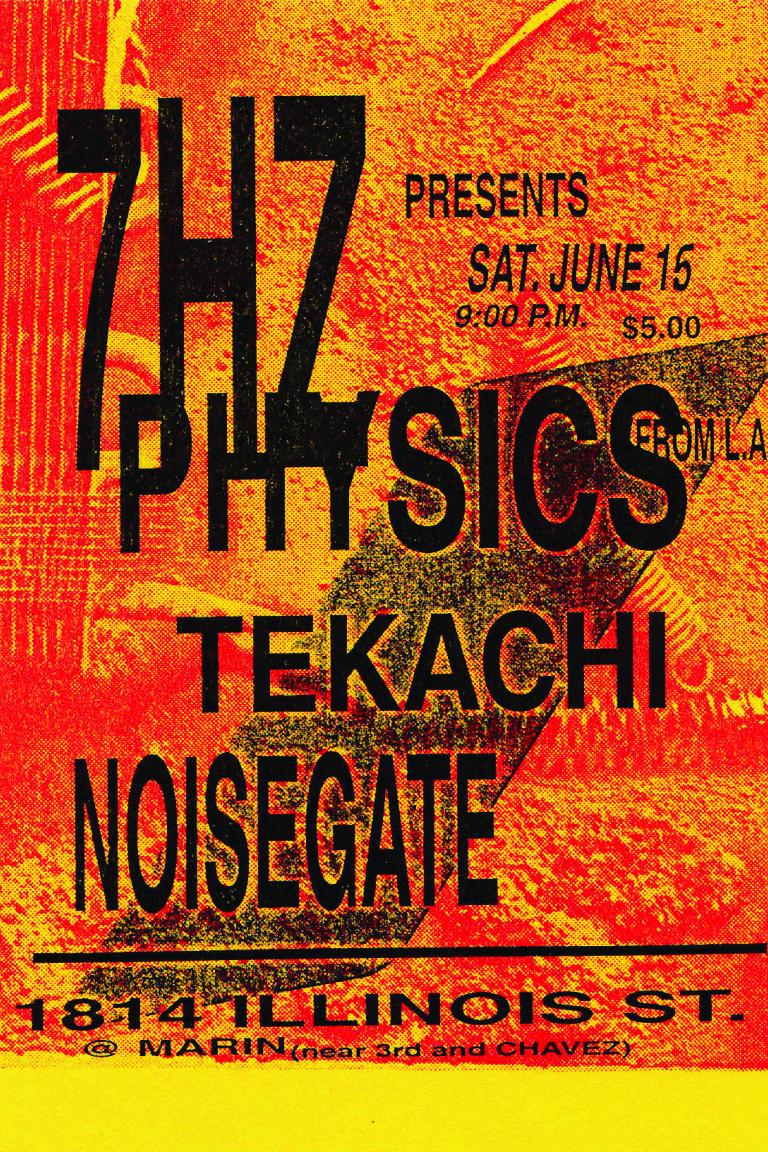
During our conversations for this article, Arford recalled finding a fortune cookie around that time with an oddly relevant piece of advice: “Use whatever technology is available to you.” He immediately embraced that encouragement when one of his 7hz roommates moved out, leaving behind a Realistic-brand reverb unit. Arford adopted the equipment and paired it with a portable shortwave radio; together, they became the sources of his first recording, Interference: Pattern (1995), released on cassette on his 7hz label in a limited edition of one hundred copies.
The repurposing of inhabited space is a recurring feature in Arford’s work. Before moving to the Bay Area, he studied architecture at Kansas State University. In everything I have seen him make, there is an ever-present sense of space being delineated and claimed. His collaboration with Randy Yau as Infrasound is perhaps the clearest embodiment of sound as perceived architecture. In their articulation of the project, this merging of elements is made explicit.
“The goal is internal and external realization,” Arford says. “It’s about provoking new modes of perceiving and experiencing one’s own body, triggering variable and autonomous psychological responses. It’s about a total acoustic sense of space, observing sound to measure the capacity of architecture. It’s about the phenomenon of resonance or sympathetic vibration, all things working in one continuum.”
This concept of perceived space as an alternate reality carries into another installation by Arford, one of my favorites. Total Static Takeover (2003) is a multi-layered work consisting of video, typed text, and a website. It forces an amalgamation of space that exists unclaimed.
Total Static Takeover declares all erroneous video transmission and/or reception to be part of an ongoing video work. In a manifesto-type statement on his website, he proclaims: “I, Scott Arford, hereby decree that from this day forward, April 13, 2003, all instances in which the phenomena of VIDEO STATIC occurs shall be constituted as a screening, partial screening, or instance of the video TOTAL STATIC TAKEOVER.”
The work echoes conceptual art projects such as Elgaland-Vargaland, an imaginary country established in 1992 by artists Leif Elggren and Carl Michael von Hausswolff. The Kingdom of Elgaland-Vargaland (KREV) claims “all boundaries between other nations, as well as Digital Territory and other states of existence. Every time you travel somewhere, and every time you enter another form, such as the dream state, you visit Elgaland-Vargaland.”
Similarly, the International Necronautical Society (founded in 1999), whose first committee included writer Tom McCarthy as General Secretary and Simon Critchley as Head Philosopher, seeks to colonize a space we will all eventually enter: the territory of death. For them, our passage into definitive extinction allows for an ultimate entrance into an unknown space of possibility. Manifest death, in their view, is not confined to its literal meaning. According to the organization’s Founding Manifesto:
“This term must be understood in the most versatile way possible. It could designate a set of practices, such as the usurpation of identities and personae of dead people, the development of specially adapted genetic or semantic codes based on the meticulous gathering of data pertaining to certain and specific deaths, the rehabilitation of sacrifice as an accepted social ritual, the perfection, patenting and eventual widespread distribution of Thanadrine™ (chemically induced death experiences)...”
Intangible architecture is another recurring spatial theme in Arford’s work. During our conversations, he mentioned the romantic conceit of architecture as solidified sound or frozen music. In Static Room (1999–), his ongoing series of performances and installations for sound and projection, these two realms converge to form a unified, immersive environment. In his own words:
“These projects merge the audio and visual environment into a single whole. The raw video signal itself generates the audio component. Thus, the video is composed and created for its sound qualities as much as for its visual qualities.
“The result is an immersive, synesthetic environment where the perceptual and physical qualities of sound and light merge to create a direct singular experience. Tones and abstract color fields break down into vibrating sheets of interlaced flickering and shredding static. The abstract projections and resultant sounds make it possible to hear the buzzing images and see the flickering sounds.”
Four years ago, Scott moved from the 7hz space to Oakland as part of the ongoing migration that has been draining San Francisco of its arts community in the wake of the tech boom. His new home is a spacious Victorian house in a yet-to-be-gentrified gray corner of Oakland. Parties still happen, but the concerts are gone. It is very much a home and feels divorced from the idea of a space geared toward live performance.
In 2012, Arford began a new project alongside Holly Herndon and Mat Dryhurst called Total Accomplishment, exploring ways of breathing new life into Belgian New Beat electronic dance music, which they renamed “New Body.” The group was short-lived but played a handful of very danceable shows in the Bay Area.
Of late, Arford has been playing solo shows and has just released a cassette, Music for a Candlelight Murder (2014), on AMK’s Banned Productions label. He is putting the finishing touches on an ambient noise album, Sleepless (released by Chondritic Sound in 2017). Later, he will take part in a project at the new incarnation of San Francisco's long-standing experimental art space, The LAB. The project involves the exhumation of archival video material from Arford’s performances there before 2000. As the space itself has undergone massive reconstruction, it will be interesting to see Arford inhabit this familiar structure with his spectral and sonic latitudes.


